
Purple vs Red vs Blue Guitar Straps: Which LED Color Makes You Stand Out On Stage?
.jpg/v1/fill/w_320,h_320/file.jpg)
If you've ever watched a headliner command a stage with nothing but their instrument and pure presence, you know that visibility matters. In the world of live performance, your gear isn't just functional: it's part of the show. And when you're playing in venues with unpredictable lighting, smoke machines, and spotlights aimed everywhere except where you're standing, an LED guitar strap can be the difference between blending into the background and owning the stage.
But here's where it gets interesting: not all LED colors perform the same way under stage lights. A purple guitar strap might look stunning in one venue and completely disappear in another. Red could pop beautifully against certain backdrops while blue cuts through haze like a laser. So which color actually makes you stand out? Let's break it down.
Why LEDs in Guitar Straps Change the Game for Performers
Traditional guitar straps do their job: they hold your instrument. But a guitar with LEDs integrated into the strap does something more: it turns you into a visual focal point. When audience members are 50 feet away in a crowded club or watching from the back of a festival field, your movement becomes trackable. Your energy becomes visible.

The technology isn't complicated. Modern LED guitar straps use sound-activation to pulse and shift in sync with your playing, creating a dynamic light show that moves with you. But the real magic happens when you pair that tech with the right color choice for your specific performance environment.
Up to 40% of audience engagement in live shows comes from visual stimulation, not just audio. That means the colors you wear, the lights on stage, and yes: your LED-equipped gear: all contribute to how memorable your set becomes.
Red Guitar Straps: Bold, Warm, and Impossible to Ignore
Red is the most attention-grabbing color in the visible spectrum. It's why stop signs, fire trucks, and warning lights all use it. When you strap on a red guitar strap with integrated LEDs, you're making a statement: "Look here."
Red LEDs perform exceptionally well in:
Dark or dimly lit venues where there's minimal stage lighting
Outdoor night performances where ambient light is low
Heavy fog or haze effects, where red cuts through better than cooler tones
The warmth of red also pairs beautifully with traditional stage lighting. If your venue uses incandescent bulbs or warm LED washes, red will harmonize rather than clash. It creates a cohesive, fiery aesthetic that screams rock, blues, or high-energy pop.
The downside? Red can sometimes feel too aggressive for mellow acoustic sets or jazz performances. If your vibe is introspective singer-songwriter, red might overpower the mood you're trying to create.
Blue Guitar Straps: Cool, Crisp, and Futuristic
Blue sits on the opposite end of the spectrum, literally. It's a cooler tone, which means it behaves differently under stage lights. A blue guitar strap with LEDs gives off a modern, almost sci-fi aesthetic that works beautifully for electronic acts, indie bands, and anyone going for a sleek, polished look.
Blue LEDs excel in:
Venues with colored stage lighting (purples, blues, greens)
Outdoor daytime performances where contrast is harder to achieve
Video recording and streaming, where blue often reads sharper on camera than red
One surprising advantage of blue? It's easier on the eyes during long sets. Red can create visual fatigue for both performers and audiences after extended exposure, while blue maintains clarity without overwhelming.
However, blue struggles in certain lighting conditions. If your venue uses heavy amber or yellow washes, blue can get washed out or appear muddy. And in thick stage fog, blue doesn't penetrate as effectively as red.
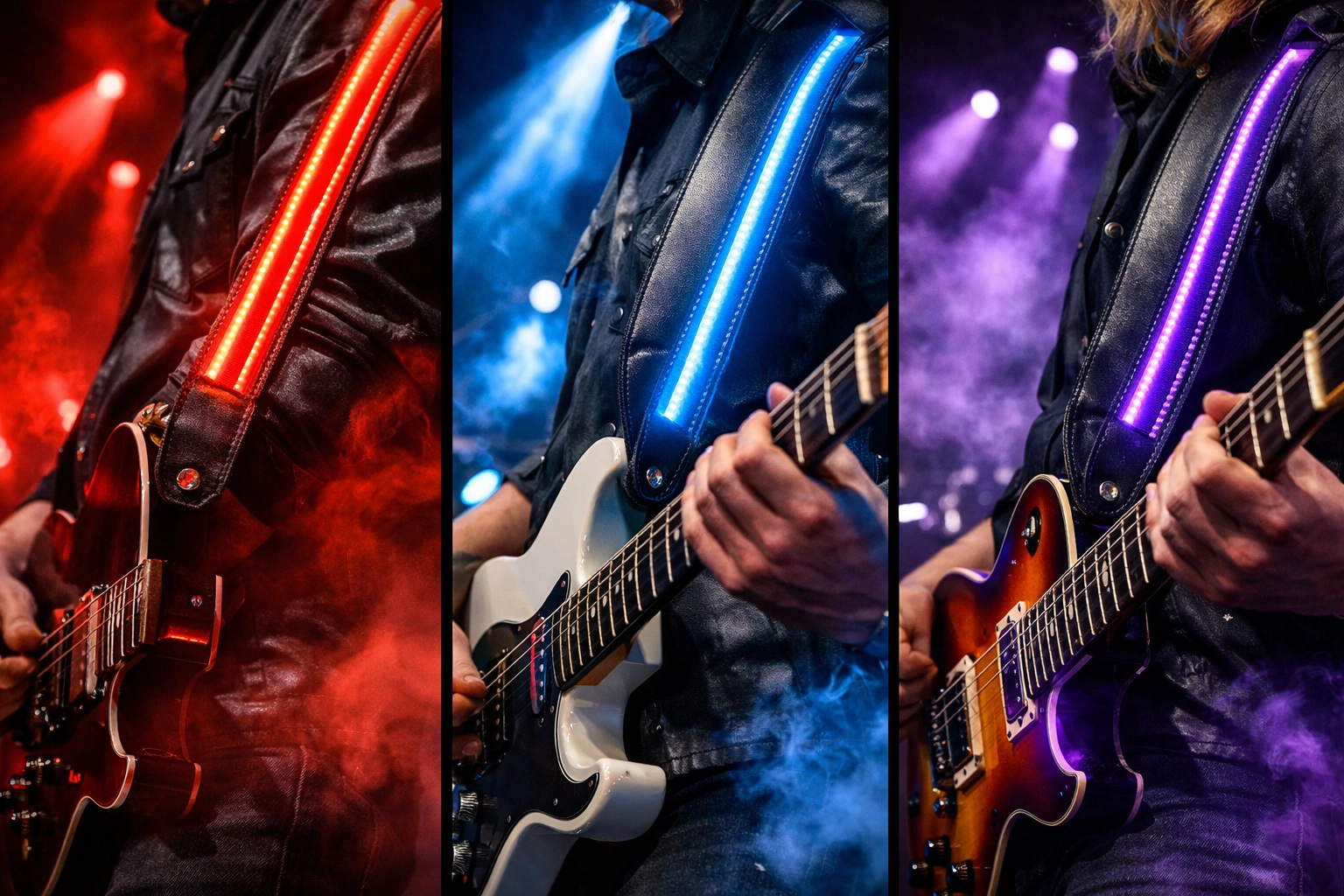
Purple Guitar Straps: The Best of Both Worlds?
Purple is where things get interesting. Technically, purple combines red and blue wavelengths, which gives it unique properties under stage lights. A purple guitar strap with LEDs offers a middle ground: it's bold enough to command attention but versatile enough to work across multiple lighting setups.
Purple performs well in:
Mixed lighting environments where warm and cool tones coexist
Alternative, indie, and experimental music scenes where the aesthetic fits the vibe
Smaller venues where you're closer to the audience and nuance matters
The "royal" quality of purple also adds a certain elegance. If your stage presence leans theatrical or you're going for a mysterious, artistic vibe, purple delivers that without feeling too aggressive or too clinical.
The trade-off? Purple isn't as universally bold as red or as crisp as blue. In some lighting conditions, it can read as a muddy blend rather than a distinct color. It's the chameleon option: great for versatility, but not always the loudest voice in the room.
How Stage Lighting Actually Affects Your LED Strap Color
Here's something most musicians don't think about: your LED on guitar isn't operating in a vacuum. Stage lighting interacts with your strap's color, sometimes enhancing it and sometimes fighting against it.
Color temperature matters. Warm stage lights (think traditional tungsten bulbs) will make red and purple pop while dulling blue. Cool LED stage lights do the opposite: they boost blue's visibility while softening red.
Smoke and haze amplify certain colors. Red and blue both cut through haze effectively, but for different reasons. Red penetrates due to its longer wavelength. Blue creates striking contrast against gray smoke. Purple? It depends on the density of the haze.
Distance changes perception. From 10 feet away, all three colors are equally visible. From 100 feet away, red tends to maintain its intensity better than blue or purple, which can start to fade or blend into background lighting.

Beyond Color: Why High-Quality Leather Construction Matters
Let's talk about the strap itself. An LED guitar strap is only as good as its build quality. Cheap materials and poor construction mean your tech fails mid-set, your strap stretches out, or worse: your instrument hits the floor.
High-quality leather construction solves this. Leather provides:
Durability that withstands sweat, movement, and repeated use
Comfort during long sets where a thin, cutting strap becomes unbearable
Professional aesthetic that matches the innovation of integrated LEDs
When you're investing in a guitar with LEDs as part of your stage setup, you want the base strap to be just as reliable as the tech built into it. Leather ages well, maintains its shape, and looks better the more you use it: unlike synthetic materials that fray, crack, or lose their color.
Choosing Your Color: Practical Decision-Making for Musicians
So which color should you actually choose? Here's a quick decision framework:
Choose red if:
You play high-energy genres (rock, metal, punk)
Most of your gigs are in small to mid-size venues with minimal stage lighting
You want maximum visibility from the back of the room
Choose blue if:
Your music leans modern, electronic, or indie
You perform in venues with professional lighting setups
You stream or record live performances frequently
Choose purple if:
You want versatility across multiple venue types
Your aesthetic is artistic, theatrical, or experimental
You prioritize a unique look over raw visibility
Sound-Activation Makes Any Color Work Harder
One feature that elevates any LED guitar strap: regardless of color: is sound-activation. When your LEDs pulse, flash, and respond to your playing in real-time, the color becomes secondary to the movement.
A static red light is noticeable. A red light that flares with every chord strike is captivating. The same applies to blue and purple. Sound-activation turns your strap into a living part of the performance, not just a static visual accessory.

The Bottom Line: Stage Presence Is About More Than Color
Here's the truth: the "best" color for your LED guitar strap isn't universal. It depends on your venues, your lighting, your genre, and your personal aesthetic. Red gives you boldness. Blue gives you clarity. Purple gives you versatility.
What matters most is that you're thinking strategically about your stage presence. A guitar strap with integrated LEDs: built on high-quality leather and activated by sound: immediately sets you apart from musicians who treat their gear as purely functional.
Your audience remembers what they see as much as what they hear. Give them something worth watching, and they'll keep coming back.

Comments